More Than Cute — A Cultural Phenomenon
When people hear the name Sanrio, their minds leap to the instantly recognizable face of Hello Kitty—a small white cat with no mouth, a red bow, and global fame that transcends language, age, and culture. But Sanrio is far more than a merchandising company. It is a cultural architect, a pioneer of kawaii design, and a masterclass example of how to build an empire from simple, emotionally driven characters.
Over the past five decades, Sanrio has created a universe of over 400 characters, from Cinnamoroll and Pompompurin to Bad Badtz-Maru and Kuromi. These characters aren’t merely illustrations—they’re companions designed with deep psychological strategy, timeless visual principles, and a uniquely Japanese storytelling philosophy.
This blog explores exactly how Sanrio became one of the most successful character design companies in the world, breaking down their techniques, philosophy, craft, and marketing genius.
1. Simplicity as a Superpower
At the core of Sanrio’s success is one essential design philosophy:
“Simple design makes universal characters.”
Sanrio characters are consistently:
-
Built from basic shapes (circles, ovals, rounded forms)
-
Drawn with minimal facial features
-
Designed with flat colors
-
Easy to reproduce on any product or scale
-
Non-threatening and approachable
This simplicity gives Sanrio an enormous advantage:
"Their characters become universal symbols rather than culturally specific figures."
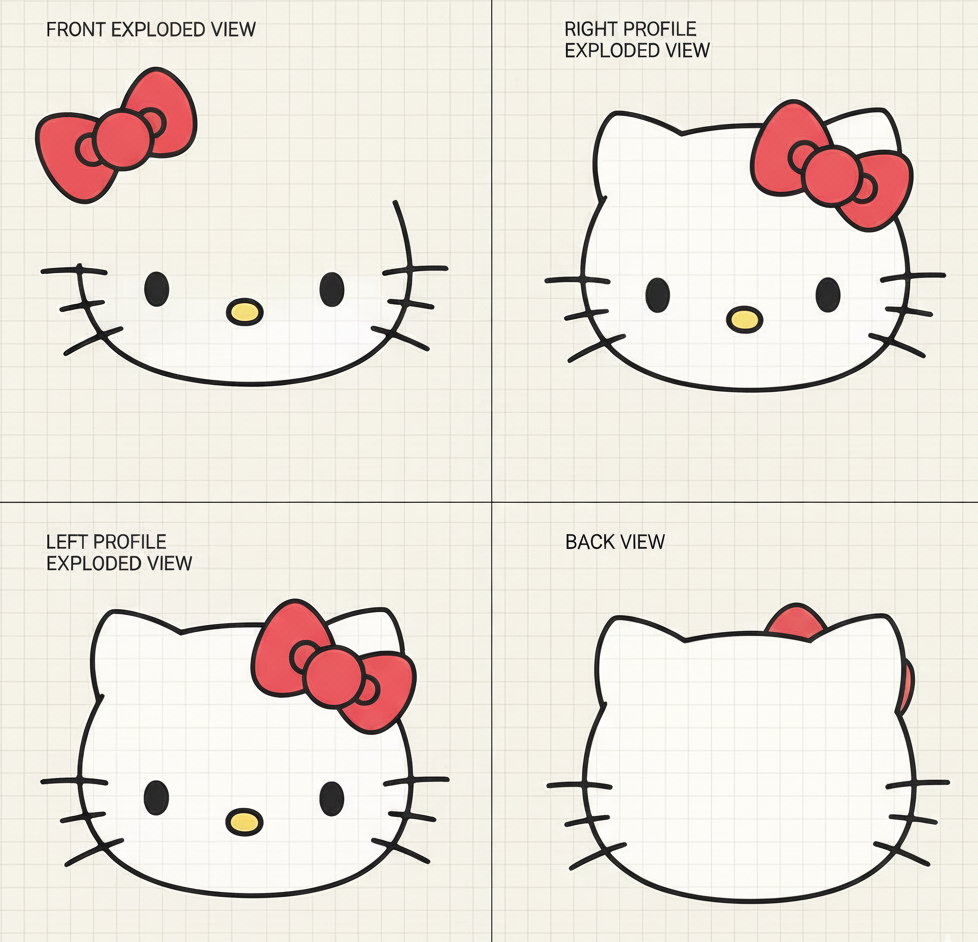
For example, Hello Kitty consists of:
-
Two dot eyes
-
A button nose
-
No mouth
-
A symmetrical head
-
A single accessory (the iconic bow)
That’s it.
Yet she is globally beloved.
This is strategic minimalism—not laziness. Simple characters give the audience room for emotional projection, interpretation, and personal connection.
They become a visual language anyone can understand, from a child in Japan to an adult in Europe.
2. The Emotional “Blank Canvas” Technique
Perhaps the most famous design choice is Hello Kitty’s lack of a mouth.
This was intentional. Designer Yuko Shimizu famously said:
“We wanted people to project their feelings onto the character.”
Without a mouth, the character:
-
Never conflicts with your emotions
-
Feels present whether you’re happy, sad, tired, or excited
-
Becomes a companion instead of a performer
-
Acts as a mirror instead of a storyteller
This emotionally adaptable design is one of the reasons Hello Kitty merchandise works in:
-
Hospitals
-
Schools
-
Fashion
-
Home décor
-
Even mental health campaigns
By avoiding strong emotional cues, Sanrio allows characters to fit any emotional situation.
It's genius-level psychology embedded in cute design.
3. Every Character Has a Story (Even If It’s Not Obvious)
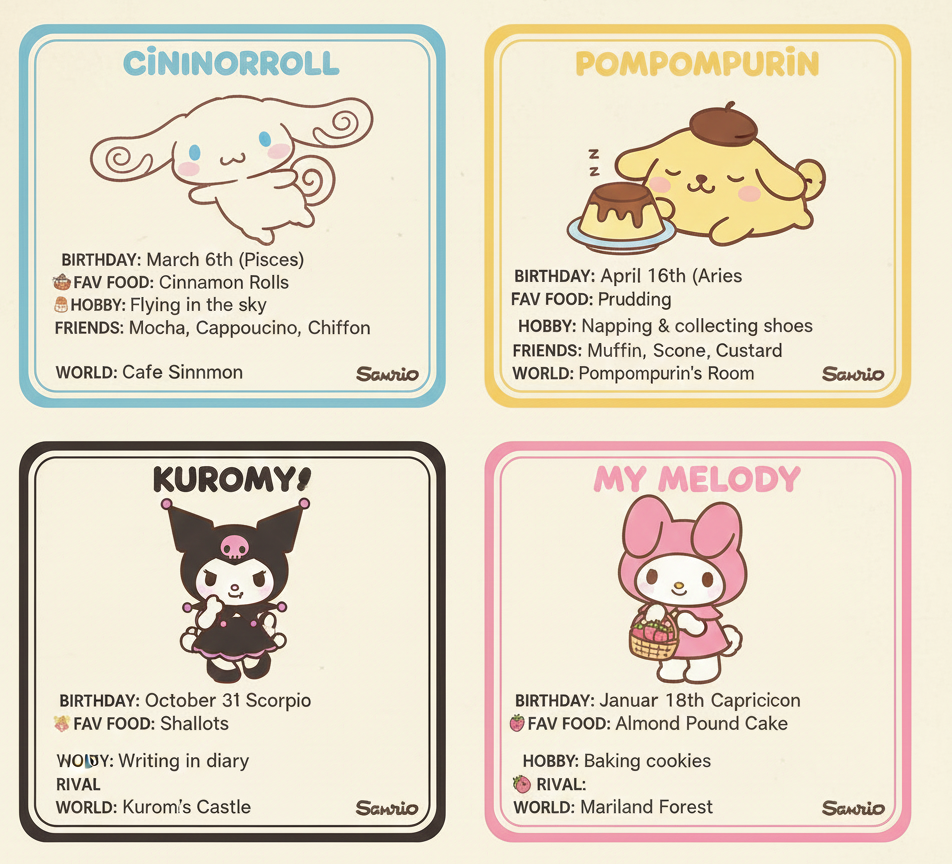
Sanrio characters look simple, but they are backed by detailed biographies:
-
Birthdays
-
Zodiac signs
-
Favorite foods
-
Family members
-
Hobbies
-
Friends
-
Their own worlds
Cinnamoroll is a puppy who flies with cinnamon-roll ears.
Pompompurin is a golden retriever who loves pudding and naps.
Kuromi is a mischievous tomboy rival of My Melody.
These stories accomplish something powerful:
They turn characters into personalities, not drawings.
When customers “know” a character, they build emotional loyalty.
Even if fans don't memorize all the lore, they feel the personality through the design.
4. World-Building: The Sanrio Universe
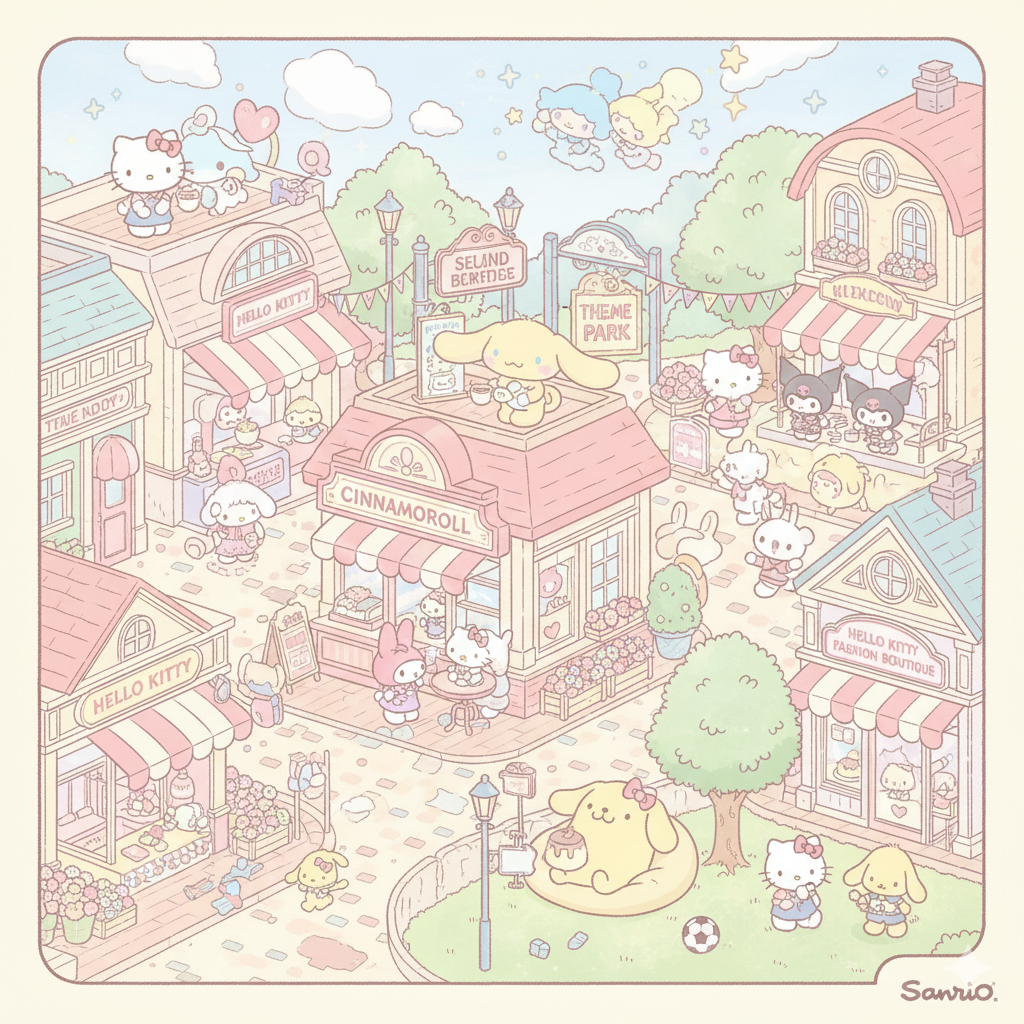
Sanrio excels in building a shared universe where many characters coexist. Unlike Disney, Sanrio’s world-building is soft, friendly, and atmospheric rather than cinematic.
Their universe includes:
-
Shared towns
-
Overlapping friendships
-
Seasonal festivals
-
Character cafés
-
Theme parks
-
Pop-up “villages” inside stores
-
Anime shows and shorts
This universe invites fans to stay engaged for years, not days.
Sanrio doesn’t just create characters—they create lifestyles.
5. Mastery of Merchandising: From Stationery to Global Fashion
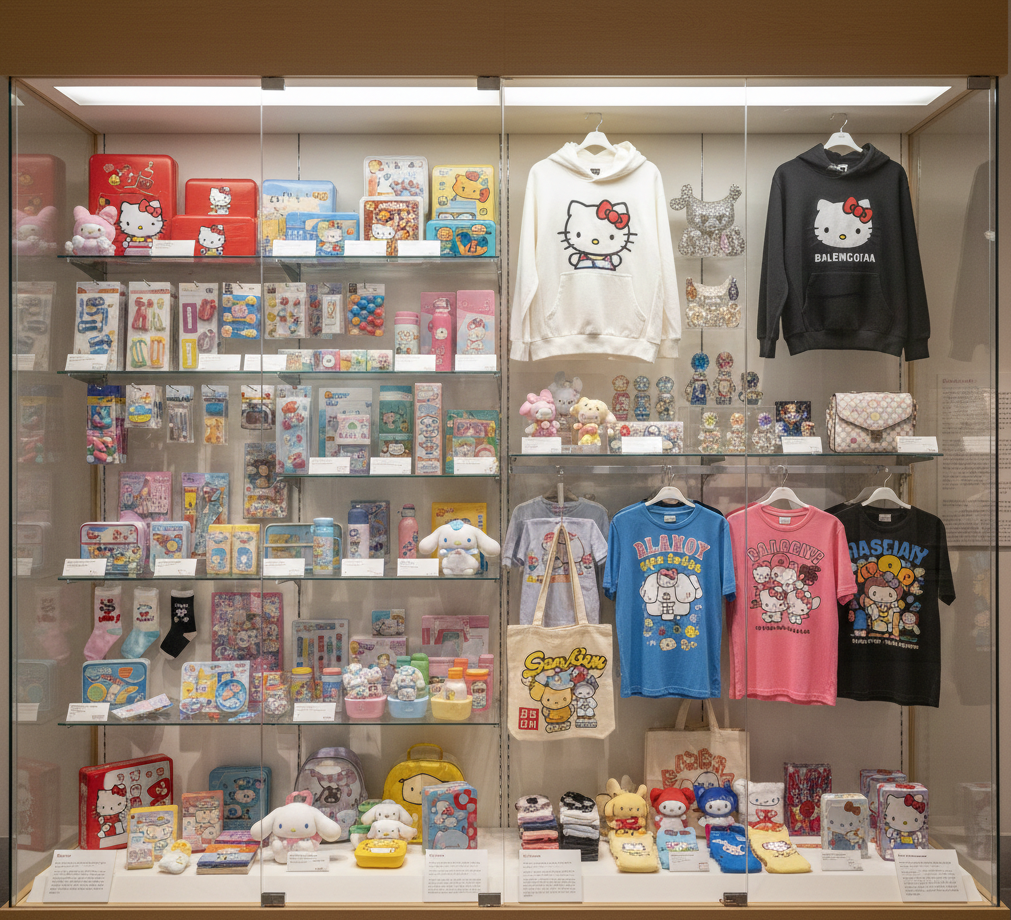
Sanrio became famous not through movies, but through products.
They built a business model many companies still study today.
Small, affordable goods brought Sanrio into everyday life.
In the 1970s and 1980s, Sanrio targeted:
-
School supplies
-
Stickers
-
Hair clips
-
Pen cases
-
Lunch boxes
-
Socks
These were inexpensive enough that children around the world could own a piece of the brand.
This strategy created:
-
Daily brand interaction
-
Multi-generational attachment
-
Repeat purchases over decades
-
Massive product diversity
Today, Sanrio licenses over 50,000 products per year globally.
From luxury brands (Balenciaga, Swarovski) to fast-fashion (Uniqlo, H&M), Sanrio characters work everywhere because the designs are infinitely adaptable.
6. The Power of Kawaii Culture
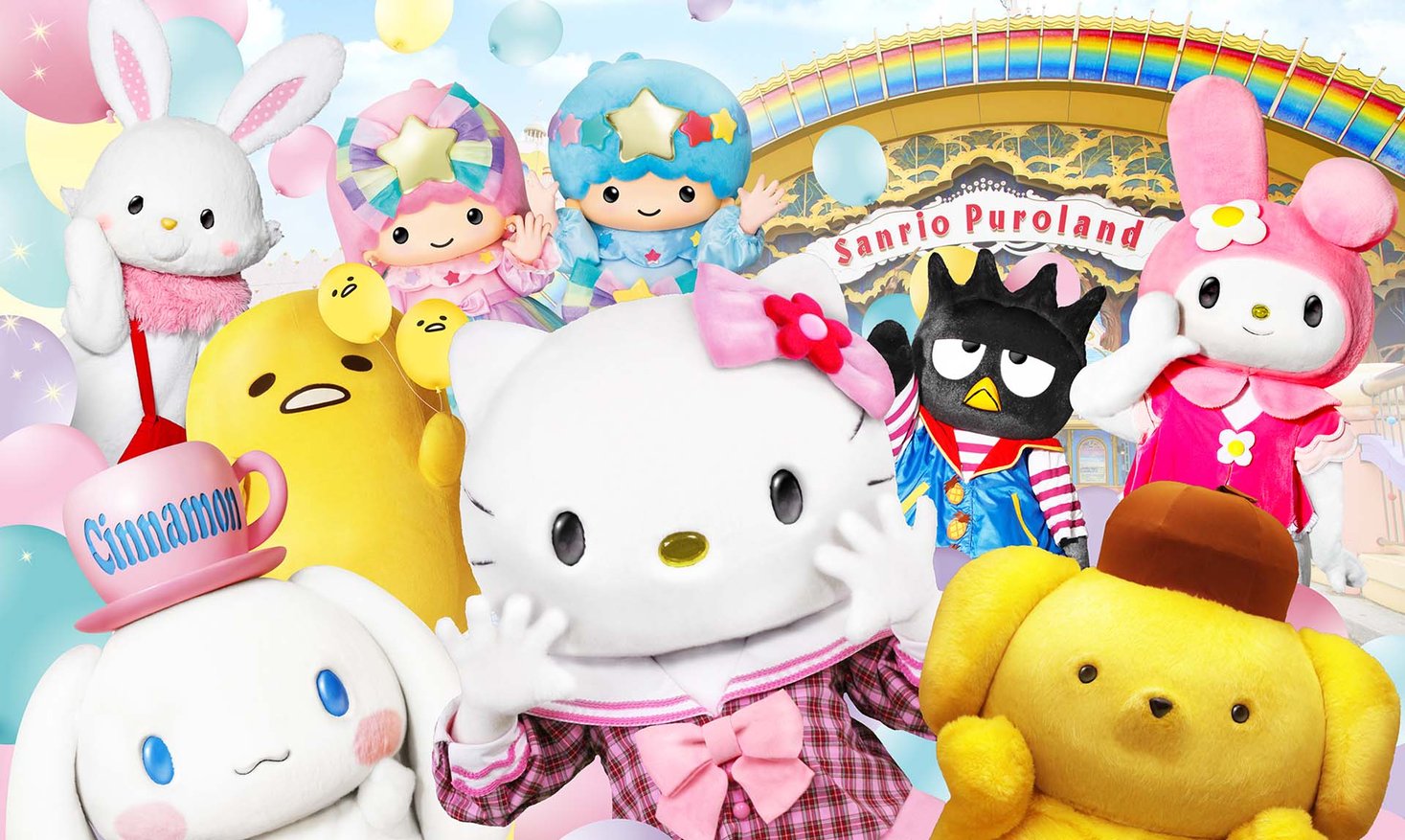
Sanrio heavily draws upon kawaii (cute) culture, which represents more than childishness
it’s a psychology of softness, comfort, emotional safety, and escapism.
Kawaii design elements include:
-
Round shapes
-
Minimal features
-
Pastel colors
-
Soft expressions
-
Cute clothing
-
Gentle proportions
Sanrio captures the essence of kawaii perfectly.
Their characters are small, friendly, unthreatening, and comforting—designed to bring emotional relief.
In times of stress, kawaii characters are psychologically proven to:
-
Reduce anxiety
-
Promote calmness
-
Make social spaces feel safer
-
Enhance mood
Sanrio’s design philosophy aligns directly with this emotional need.
7. Adaptability Across Ages and Trends
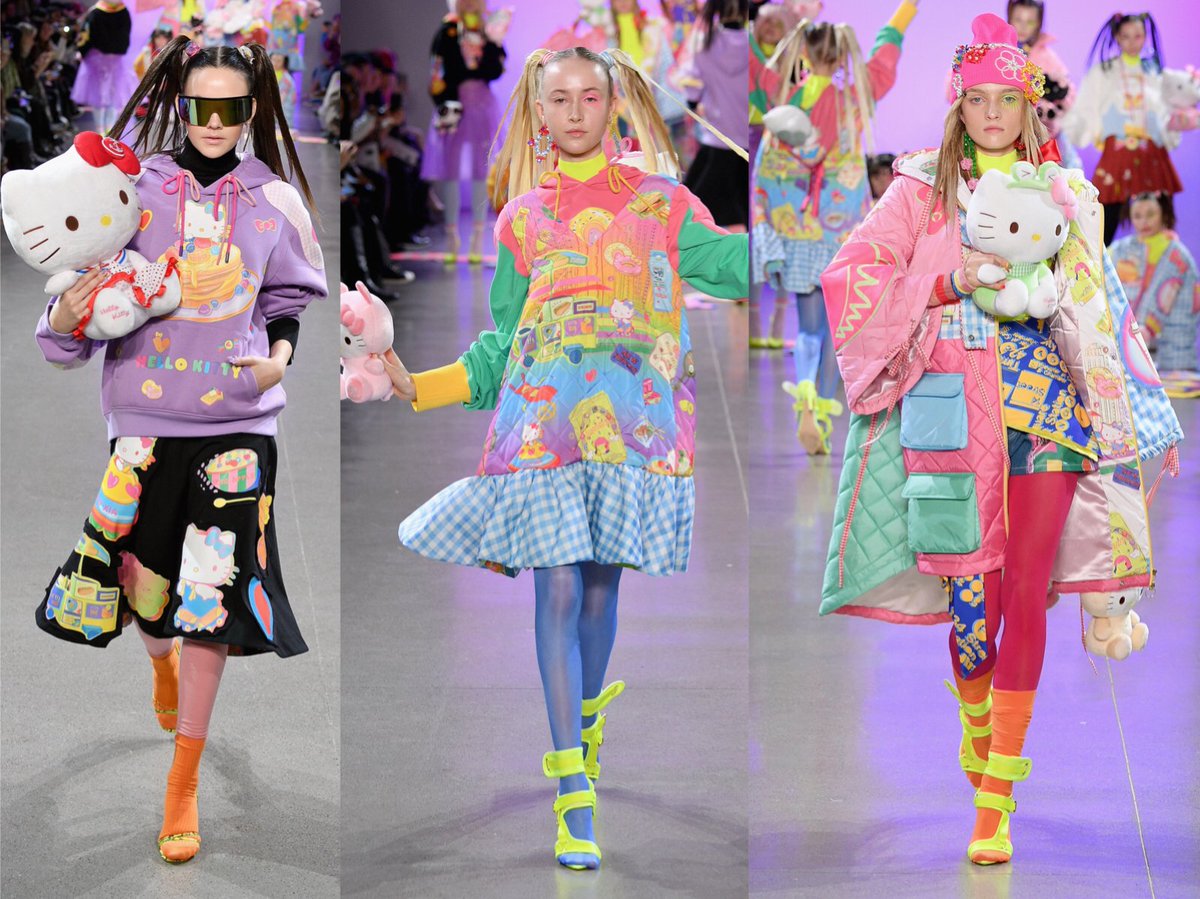
One of Sanrio’s greatest strengths is multi-generational appeal.
Age 3–9: Cute stationery, plush toys
Age 10–17: Self-expression, aesthetic identity
Age 18–30: Nostalgia, lifestyle goods, fashion
Age 30+: Home items, collectibles, comfort appeal
Sanrio evolves constantly:
-
Edgy collaborations (Kuromi streetwear)
-
High fashion partnerships (Hello Kitty x Puma, x Balenciaga)
-
Gaming communities (My Melody in Animal Crossing)
-
TikTok aesthetics (gothic kawaii, soft girl trends)
But through all the evolution, Sanrio keeps its core identity stable.
This balance is hard to achieve—and a key to their success.
8. A Consistent, Heartfelt Brand Philosophy
!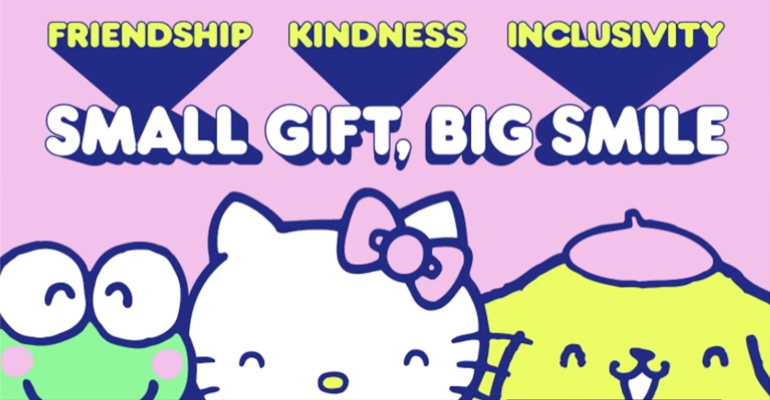
Sanrio’s motto since 1974 has been:
“Small Gift, Big Smile.”
This philosophy guides everything:
-
Products should bring small happiness
-
Design should feel warm and comforting
-
Characters should be gentle companions
-
Colors should be soft and optimistic
-
The brand should spread joy, not drama
Sanrio’s emotional consistency is one of its most powerful assets.
Fans feel the sincerity behind the brand.
9. Strong Cultural Understanding Without Limitation
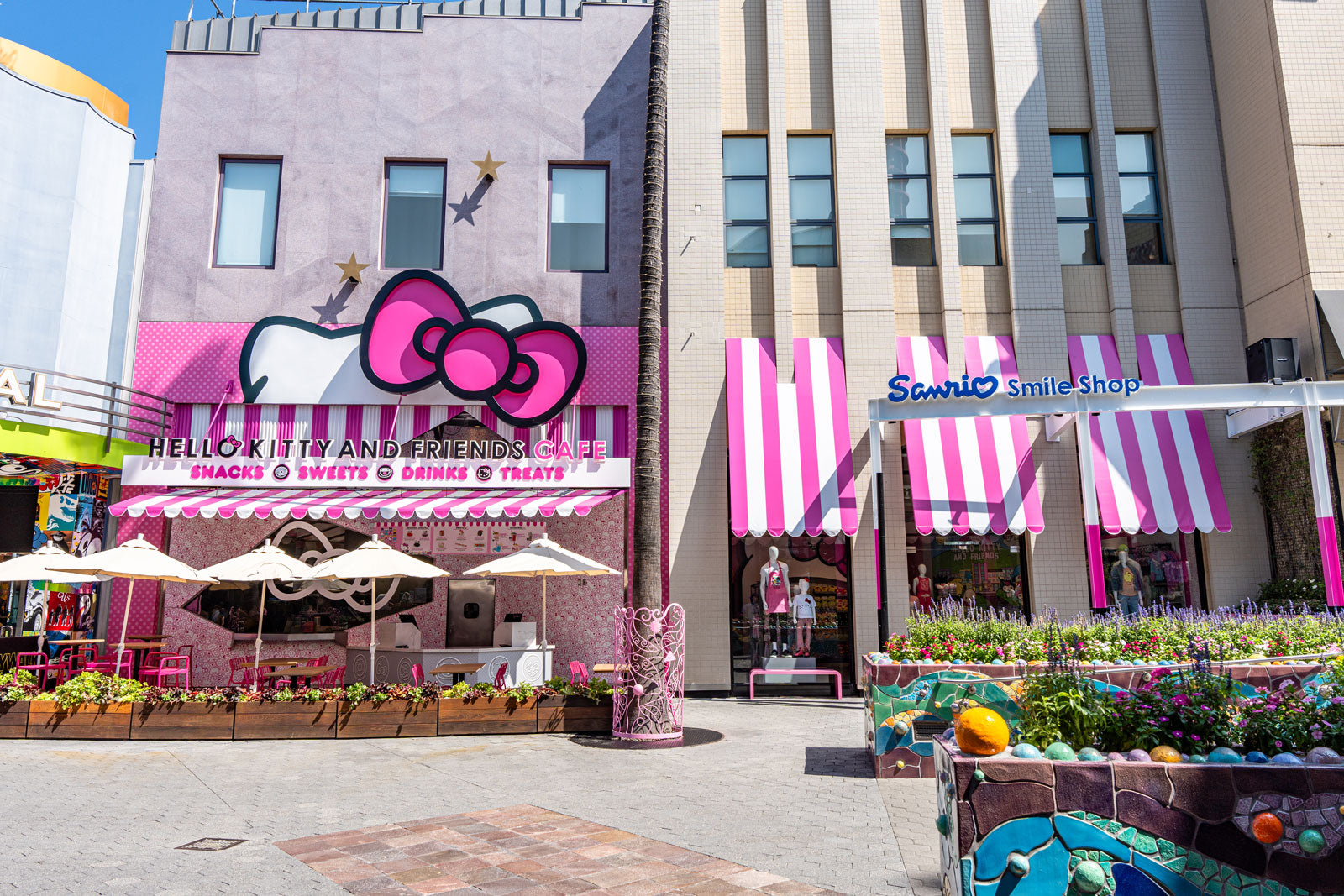
Though rooted in Japanese culture, Sanrio is not restricted by it.
They design with global appeal in mind:
-
No specific cultural features
-
No language barriers
-
Minimal backstory complexity
-
Universally recognizable shapes
-
Adaptability across cultures
This universal design makes Hello Kitty as popular in Thailand or the U.S. as she is in Japan.
10. The Talent Behind the Magic: Sanrio Artists & Designers

Sanrio has employed dozens of influential designers, including:
-
Yuko Shimizu — Creator of Hello Kitty
-
Yuko Yamaguchi — Second Hello Kitty designer for 30+ years
-
Miyuki Okumura — Designer of Cinnamoroll
These artists specialize in:
-
Kawaii proportion design
-
Visual psychology
-
Storytelling through shape
-
Emotional neutrality
-
Cultural minimalism
Their collective skills form the backbone of Sanrio’s design success.
11. Psychology-Driven Visual Design
Sanrio characters often follow hidden psychological rules:
• Large heads → childlike innocence
• Big eyes → emotional openness
• Rounded shapes → safety and friendliness
• Soft colors → reduced stress
• Symmetry → visual harmony
• Minimal expressions → emotional universality
These principles make Sanrio characters universally comforting and visually pleasant.
12. Seasonal and Cultural Relevance
Sanrio keeps characters alive through:
-
Seasonal outfits
-
Holiday campaigns
-
Regional variants
-
Limited-edition themes
-
Cultural celebrations (Sakura, Christmas, Lunar New Year)
This strategy creates urgency, collectability, and endless fresh engagement.
Sanrio’s Secret Isn’t Just Cuteness — It’s Emotional Design
Sanrio’s unmatched success in character design comes from combining:
-
Simplicity
-
Emotional psychology
-
Storytelling
-
World-building
-
Kawaii culture
-
Merchandising mastery
-
Brand sincerity
-
Timeless adaptability
Sanrio characters are more than products—they’re emotional companions that follow people through childhood, adolescence, adulthood, and even parenthood.
They make people smile in small ways, every day.
And that’s the real magic.
References
-
Fujimoto, Yukari. Kawaii Culture and Japanese Society. Japan Studies Journal, 2015.
-
Sanrio Co., Ltd. Official Character Encyclopedia. (Sanrio Publications, 2020).
-
Yuko Yamaguchi, Interview with NHK World Japan, “The Hello Kitty Phenomenon,” 2018.
-
Sharon Kinsella, Cuties in Japan: The Meaning of Kawaii. Routledge, 1995.
-
Sanrio Corporate History. Sanrio Official Website.
-
The Psychology of Cute (Kawaii) Design. Journal of Consumer Psychology, 2017.
-
Sanrio Marketing Case Study, Harvard Business Review, 2019.